The Trim and Thread Buying Plan
Buy trims and thread once: the pattern scaled honestly, every edge measured where the trim sits, corners, joins and shrinkage as their own lines, gathered trim by its fullness, cards counted by whole pieces, the cut rounded once at the counter, and thread one cone per needle and looper
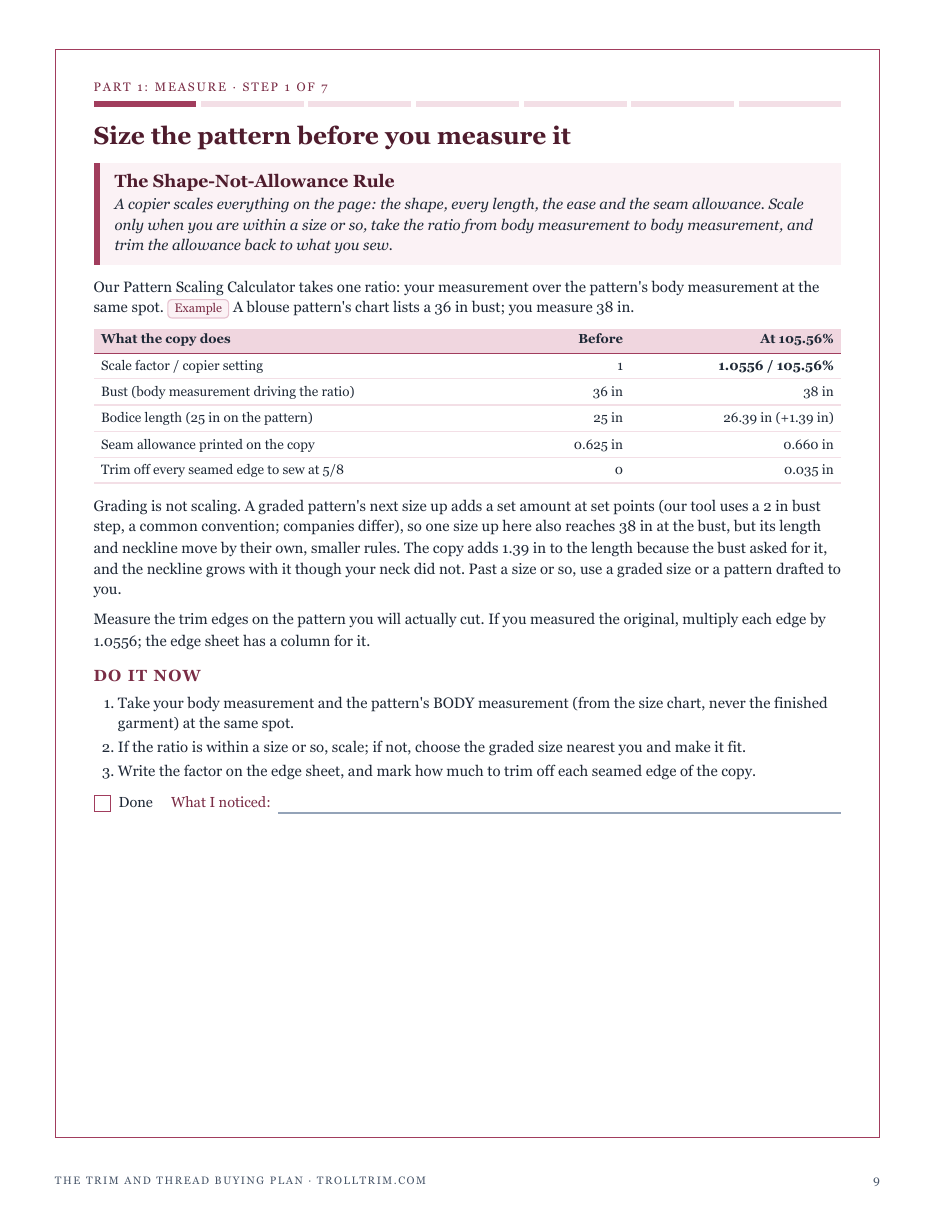
TrimCraft's free Trim & Ribbon Quantity Calculator sizes one edge with one blanket overage, and the Thread Consumption Estimator sizes one stitch type. Neither knows that gathered lace is a ratio and not a percentage, that a piece of trim cannot be spliced across two cards where it shows, or that the counter sells in steps. Writing this plan we also fixed the tools: thread now uses Coats' published ratios (a 3-thread overlock is 14.0, not the 7 the tool used) with one cone per needle and looper, cards are counted by whole pieces (six 24 in cuffs on 36 in cards are 6, not 5), and the scaling tool shows the seam allowance a scaled copy actually prints. This plan puts the project together. In its worked example a blouse pattern is scaled from a 36 in to a 38 in bust (105.56%, which also adds 1.39 in to a 25 in bodice). The square neckline's braid needs 29.33 in with two mitered corners and the join; the gathered cotton lace hem needs 118.56 in at a fullness of 2 after a washed sample kept 97%, where the usual 10% gives 62.7 in. The lace is longer than a 3 yd card, so it is cut in one piece at 3 3/8 yd; the whole trim list is $20.45 at example prices. The serger's 4-thread seams use 69 yd over four cones, the loopers 25.9 yd each, so a 20 yd stash cone belongs on a needle. Every figure is computed by code from the site's own tools and is an example for you to replace; thread ratios are quoted from Coats and gathering ratios from two sewing references that disagree, so you test yours on a sample. For children's clothing it quotes the CPSC drawstring rule and sizes no drawstring for a child. Included: seven steps, four working pages (edge sheet, trim buy sheet, thread and cone sheet, counter card), reference tables and a quickstart, plus a personalised sheet worked from the numbers in your calculators.
Look inside
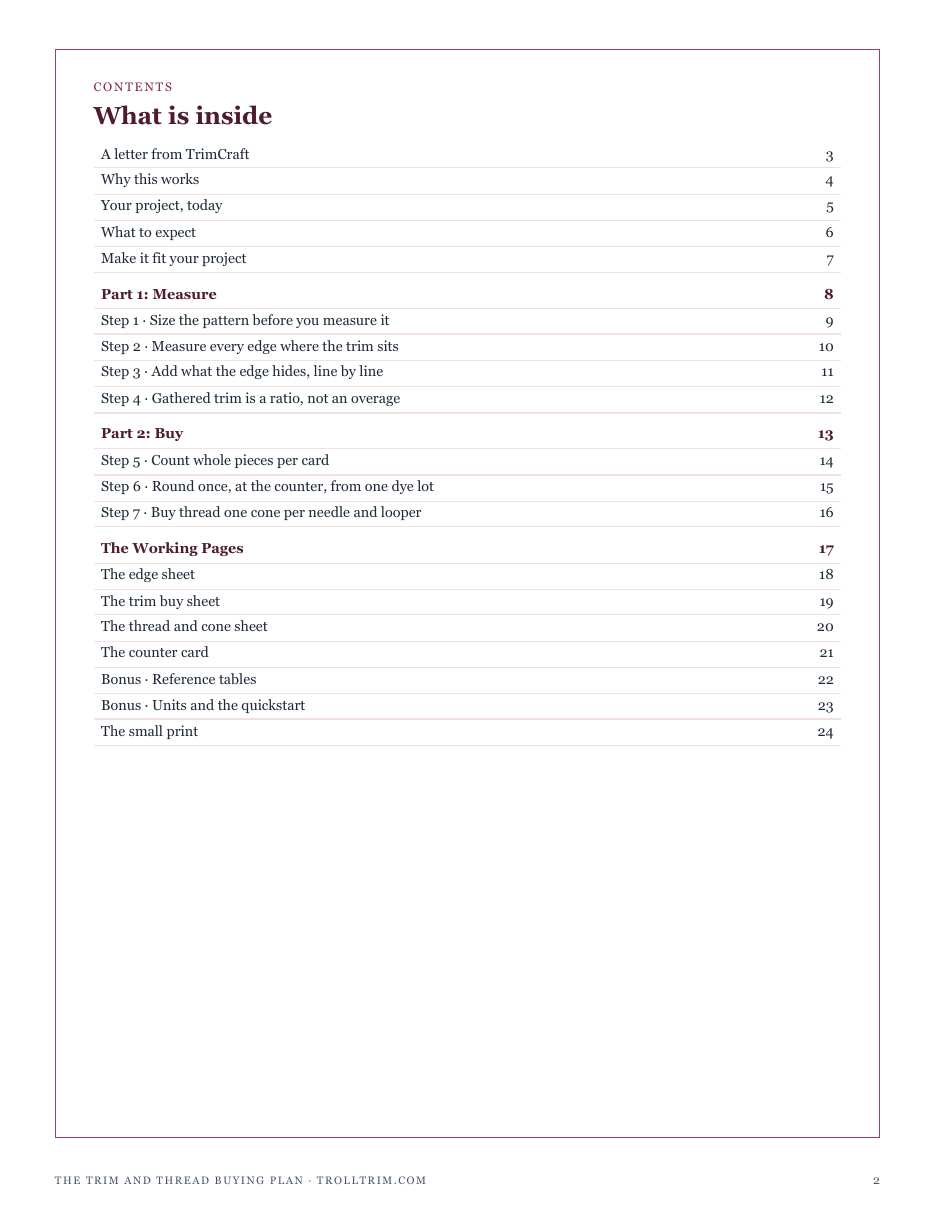
Two full pages from the plan, exactly as printed. Click either to read it at full size before you decide.
What is in it
- Step 1: the pattern scaled body to body, what a copier does to length, ease and the printed seam allowance, and when to grade instead
- Step 2: every edge measured where the trim sits, curves with a string, matching edges counted as pieces
- Step 3: corners, the join and shrinkage as their own lines, from a folded miter and a washed sample
- Step 4: gathered trim sized by your own fullness, tested on a sample, with the published ratios side by side
- Step 5: cards and spools counted by whole pieces, so no piece is spliced where it shows
- Step 6: the cut rounded once to the counter's step, cards priced against a cut, one trip and one dye lot
- Step 7: thread from Coats' ratios by stitch class, split by needle and looper, and every stash cone checked against its position
- Four working pages: edge sheet, trim buy sheet, thread and cone sheet, counter card
- Reference tables: Coats' full thread consumption table with yards per 100 in, gathered lengths at four fullnesses, inches, centimeters, yards and meters
- A quickstart, and a personalised sheet worked from your own calculator inputs
- ✓ 24 printable pages
- ✓ 10 sections, worksheets and templates
- ✓ A second PDF worked out from the numbers you enter
- ✓ No account needed, just an email address
- ✓ Instant download; link valid 7 days
Price includes any taxes. Sold by GrabURL, who handle checkout and support. The charge appears on your statement as GrabURL.
The plan picks up where the free Trim & Ribbon Quantity Calculator and Thread Consumption Estimatorleave off. They size one edge and one stitch type; the plan sizes the whole project: the pattern scaled honestly before it is measured, every edge measured where the trim sits, corners, joins and shrinkage as their own lines, gathered trim by its fullness, cards counted by whole pieces, the cut rounded once at the counter from one dye lot, and thread bought one cone per needle and looper from Coats' published ratios. Every figure in it is an example for you to replace.